Going from trust to proof: How AI is changing operations
Tarush Aggarwal · August 2026 · 7 min
- Sector
- Charity, education
- Region
- Bali, Indonesia
- Company
- US charity, 128 kids in 5 orphanages
- Before
- 1 to 2 days a month, ending in trust
- After
- Under 2 hours a month, ending in proof
- Unlocked
- Streamlined operations
TL;DR
Running this charity end to end takes under two hours a month. It used to take a day or two and it ended in trust.
The same setup can scale to thousands of kids taught by teachers who do not work for them, with every class checked and every child's progress measured. This is the future of building trust inside every process.
Any operation where the work happens away from a desk has to answer one question: how do you know it was done. There have only ever been two answers:
- Put a system in place to check it. Audits, spot visits, sign-off sheets, a supervisor on the floor. All of it carries overhead, and until recently it was challenging to verify the work itself, so it ran on proxies: a signature, a head count taken in the hour somebody was standing there. That added some verification, but people could work around it, and they always did.
- Take their word for it, which is what most operations run on. It works while you are small enough to know everyone personally, and past that you are carrying risk you have no way to size.
Why operations scale by hiring
Operations blend the two, which is why headcount grows. Verifying what actually happened has meant hiring: a supervisor over the layer below, a regional manager over the supervisors, each a salary paid for assurance rather than output. It still only buys a sample. Four site visits a month tells you about four days out of thirty.
Software never fixed it, because software ran on forms, and a tick box is the operator's claim in a tidier format. The real evidence was images, video and audio, with no affordable way to read them at volume. CCTV came closest and mostly worked as a deterrent.
What changes with AI is that those inputs are now readable at a price and volume that work in daily operation. A photograph records a place at a moment and carries metadata the operator never composed, which makes it evidence rather than testimony.
Our case study: a US based charity operating in Indonesia
Meant for Greatness teaches English to kids in orphanages in Indonesia. Today that means Bali: 128 active kids across five orphanages, taught by professional teachers who come to the orphanage and run the class. Small groups, three sessions a week, a structured curriculum.
The problem it exists for, in one line from their site: a child growing up in a Bali orphanage without English ends up in informal labor earning $100 to $190 a month, and the same child with English can work in Bali's tourism economy, where hotel and guide jobs pay $500 to $1,150.
The solution, also one line: fund consistent, structured English classes at orphanages across Bali, delivered by paid professional teachers who visit every afternoon.
It is a small operation with the full version of the problem. The classes happen in five buildings nobody from the funding side is standing in, they are taught by partner teachers rather than employees, the money moves between two countries, and the people paying for it are donors who are entitled to know it happened. Hiring a layer of supervision to check all of that would consume the donations.
So we built them an operating system to run it.
Everything below is the real admin panel. Kid and teacher names have been replaced with fakes and every uploaded photo is blurred, because these are real children on the other side.
Use case one: enforcing that the classes are delivered
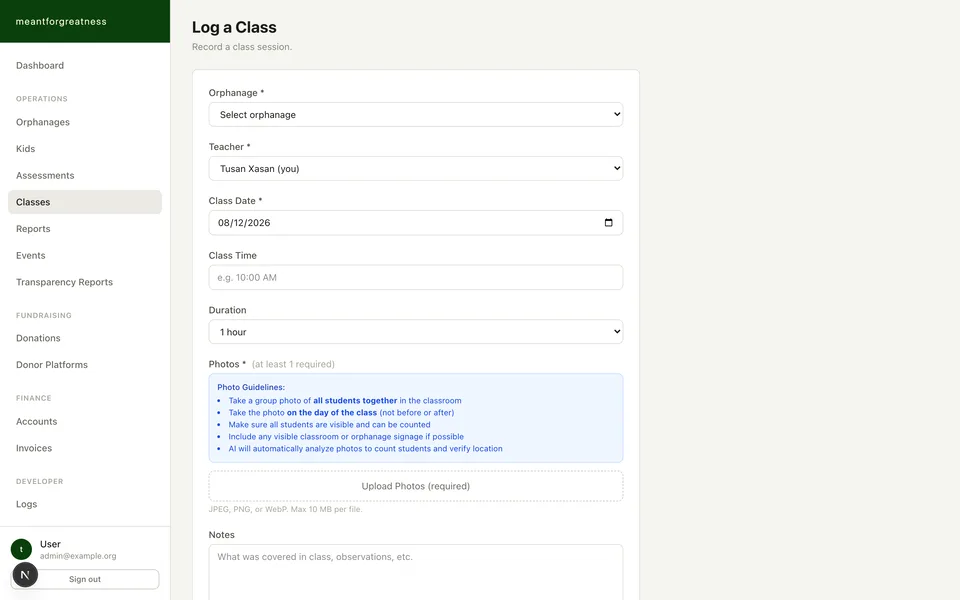
The teacher logs the class from their phone while it is happening. A few basic fields, date, time, class group and who was there, and then a photo of the kids in the room, taken at the start or the end of the session. The photo is the part that does the work.
Three independent things come out of the one image:
- What is in the frame. Claude counts the children and describes the setting.
- When it was taken, from the EXIF timestamp the camera wrote.
- Where it was taken, from EXIF GPS, converted to a distance from the orphanage's coordinates.
All three get compared against what the teacher typed. That matters because the teacher only controls one half of it. They choose what to enter. They do not set the timestamp, the GPS, or the number of kids the model counts. If the two halves agree, the class is confirmed and nobody looks at it again. If they disagree, it gets flagged and someone opens it.
Across every class analyzed so far:
- 5.1% had a photo taken on a different day to the class date.
- 4.0% were taken outside the class time window.
- 4.8% had a head count more than two off the number the teacher entered.
Nearly all of those resolve into something ordinary when a human opens them. A teacher photographed the room the following morning. A phone was set to the wrong time zone. Nobody is being policed here. Verification is built into the act of recording a class, so every class gets checked without a person deciding which ones deserve a look, and at about a cent a picture it costs less to leave on than to target.
Use case two: checking that the kids are learning
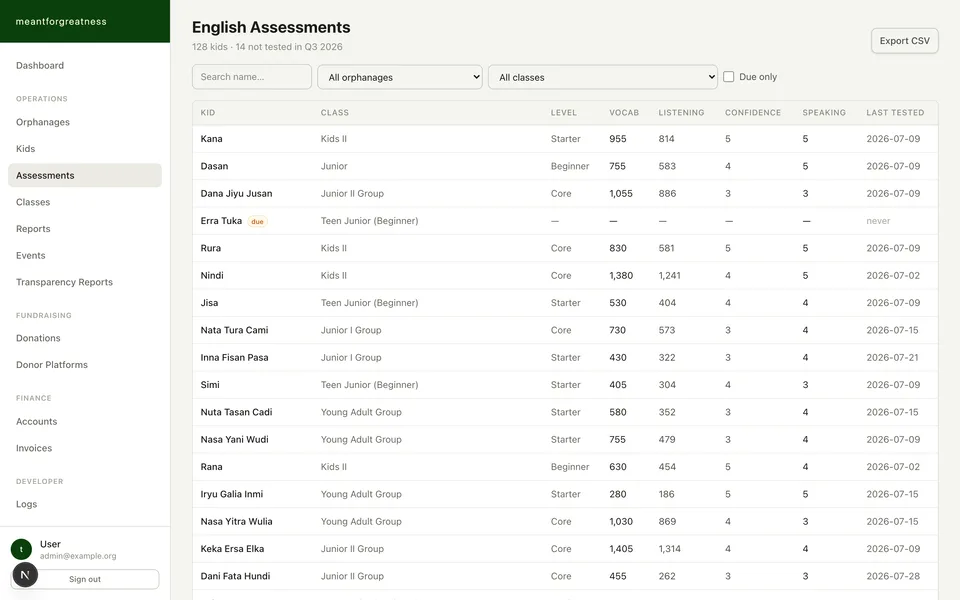
Making sure the classes are taught is half the equation. The other half is whether the kids are progressing, so we built our own standardized test into the platform. There are four versions of it for different stages. Every kid takes the same version each quarter, so the quarters can be compared.
Four parts:
- Vocabulary. An English word with an example sentence, and four options in Bahasa Indonesia to choose from.
- Listening. The same, on words the child hears instead of reads.
- Speaking. A short recording the teacher rates.
- Confidence. Two ratings out of five, one from the teacher and one from the child, which catch the kid who scores well and still will not speak in class.
A teacher can run it from the admin panel, or send a single-use link so a child takes it on their own device without an account.
The OS underneath
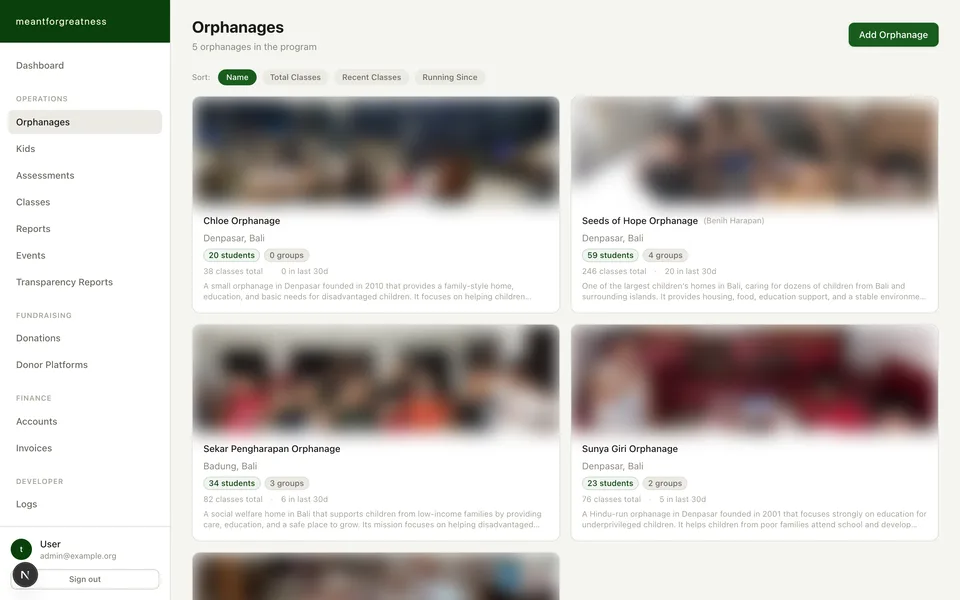
Both of those sit on top of the OS we built for them. It holds the orphanages, the class groups, the kids and every class that has been logged.
Second order benefits
Operational automation tends to have multiple second order benefits. Automate one part of your process and you probably get the downstream automation for free.
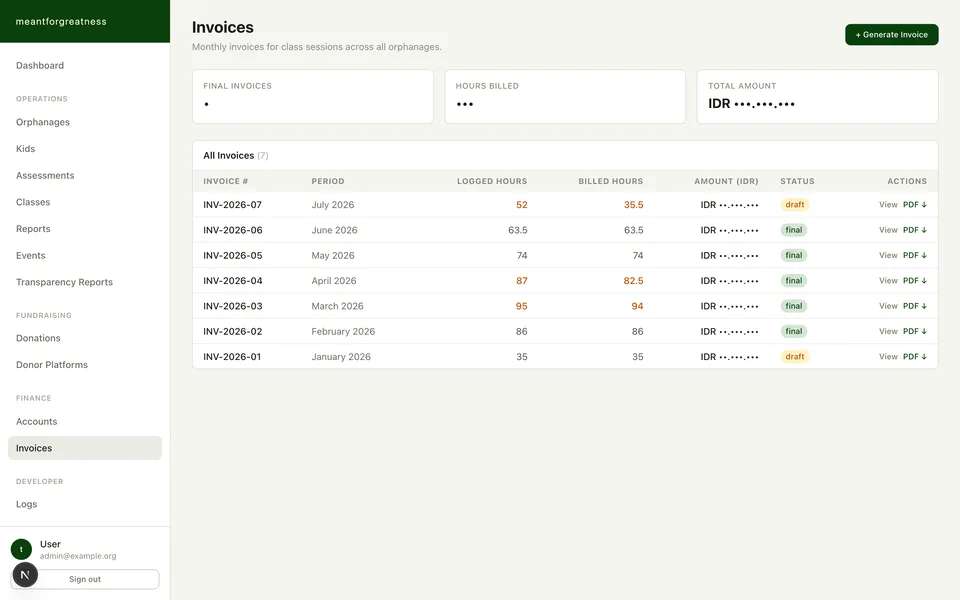
Here that was invoice generation. Once every class is a structured record that has already been checked, the month-end invoice is a query over those records: hours per orphanage at the agreed rate, plus any additional items, with the billed figure editable where a human needs to overrule it. Every billed hour resolves to a class log with a photo behind it, and generating the invoice is a ten second job.
Then the bank side came with it. The accounts sync through their APIs, so every transaction is audited against the same system that holds the classes and the invoices, and the runway falls out of that automatically. As classes and kids get added you can watch it move.
Running the whole operation now takes under two hours a month and ends in verification. The same job used to take one or two days a month and ended in trust.
What this gives donors
One more second order benefit. Donors get the kind of visibility into where their money goes that should start to become the standard in this industry.
FAQ
Can a teacher not just fake the photo?
It would take real effort. You would need a staged photo with fabricated metadata behind it, taken at the right place at the right time with the right number of children in it. Every picture is kept with its history, so a record that passed at the time can still be reopened and caught later. Most people cutting a corner are looking for a shortcut, and the effort this would take is probably not worth the reward.
What happens to a flagged class?
A human decides. The AI only flags; it never rejects a class and never deducts anything. Someone opens the log, asks the teacher, and makes the call.
Does this only work because it is a charity?
The pattern needs three things: work that happens at a known place and time, a person on site with a phone, and someone who cares whether it happened. Field service, facilities, franchise operations and logistics all qualify.
Tarush
Replies
Replies are open to subscribers. Join free and you can post one on the next issue too.
About the author
Tarush Aggarwal
Tarush runs teiō, building enterprise superintelligence for traditional companies. He started out as the first data engineer at Salesforce in 2011, was a founding expert at the International Institute of Analytics and a columnist for Data Scientist, the first print data magazine, then global head of data at WeWork, and founder and CEO of 5X, voted on G2 as the #1 end-to-end data platform for SMBs.
Keep reading
How hedge funds are building a context layer around Excel
Why Excel, documents and email resist AI, how a hedge fund kept every spreadsheet and got a data platform anyway, and what becomes possible once the data sits underneath.
Build vs buy: How AI is changing how we think about managing risk
Why buying off the shelf was always a risk decision, what changes when building gets cheap, and the three ways of implementing AI in your organisation.
Going from centralized to hybrid: How teiō uses AI part III
Why we stopped building the OS centrally, how business teams now ship their own branches, and when to make the switch.