Rolling out skills across the enterprise

Tarush Aggarwal · Updated October 2026 · 11 min
Most of what a company does in a week is the same work done again. Someone writes the Friday update to each customer, chases the proposal that went quiet, turns a call into action items, reviews a change against the same checklist as last time. How each of these gets done lives in someone's head, or in a doc nobody opens after onboarding.
Skills are how a lot of that work gets automated. A skill writes the job down so an AI can do it: the sources to read, the order, the format, who signs off. It sits on top of what a company already runs, its email, meetings, CRM, warehouse and internal tools, and replaces none of it.
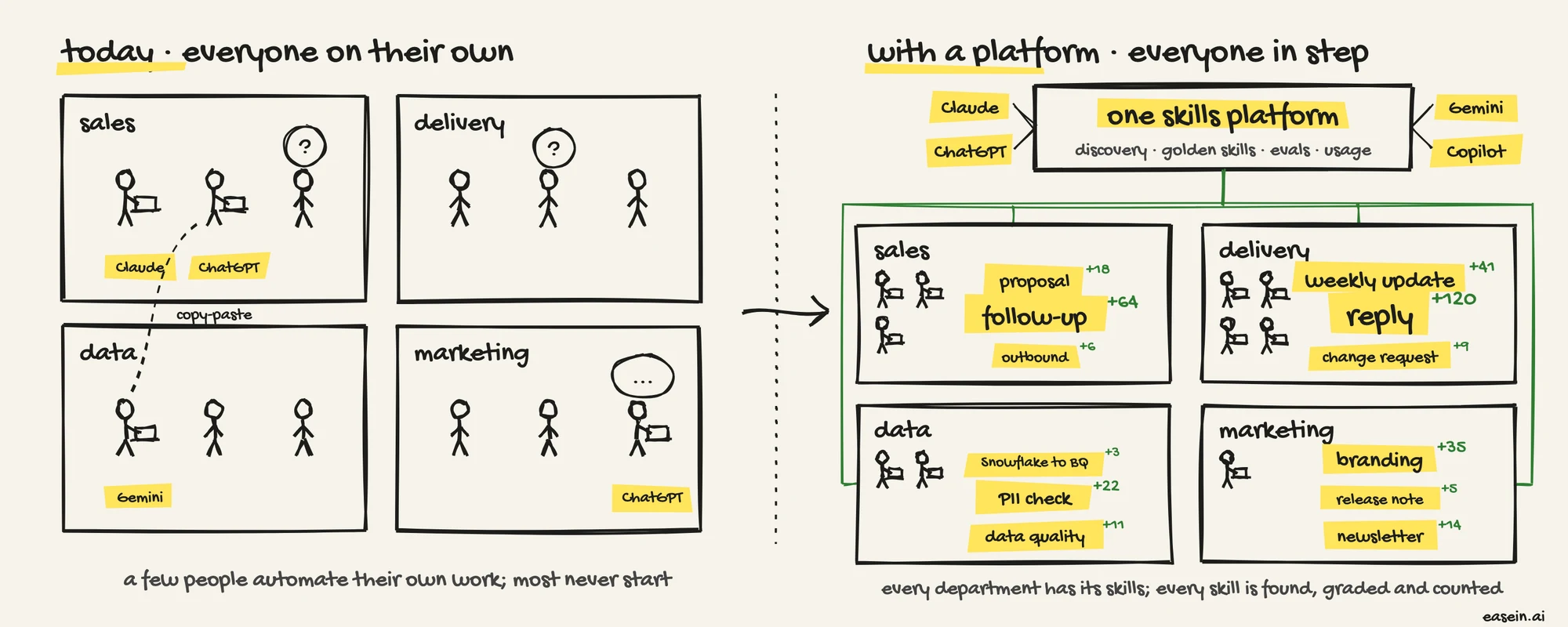
Your people are already writing skills. What is missing is the company's half: a platform you own, across every AI tool you use, that vets, grades, counts and rewards them. This playbook is how to put that half in place, in order.
Bottom up gets a company its first gains: each person automates what they do, and their own work gets faster. It stalls at the edge of each person's job. The work that crosses departments, where one team's output is another team's input, only changes when someone decides it will, and that is the top down half.
Bottom up: people automate their own function
Write down what any one person does in a week and it turns out to be a short list of jobs that repeat. That is all a role is: a collection of skills. The picture below takes three common roles and writes each one out as the skills that would do the first draft of its work:
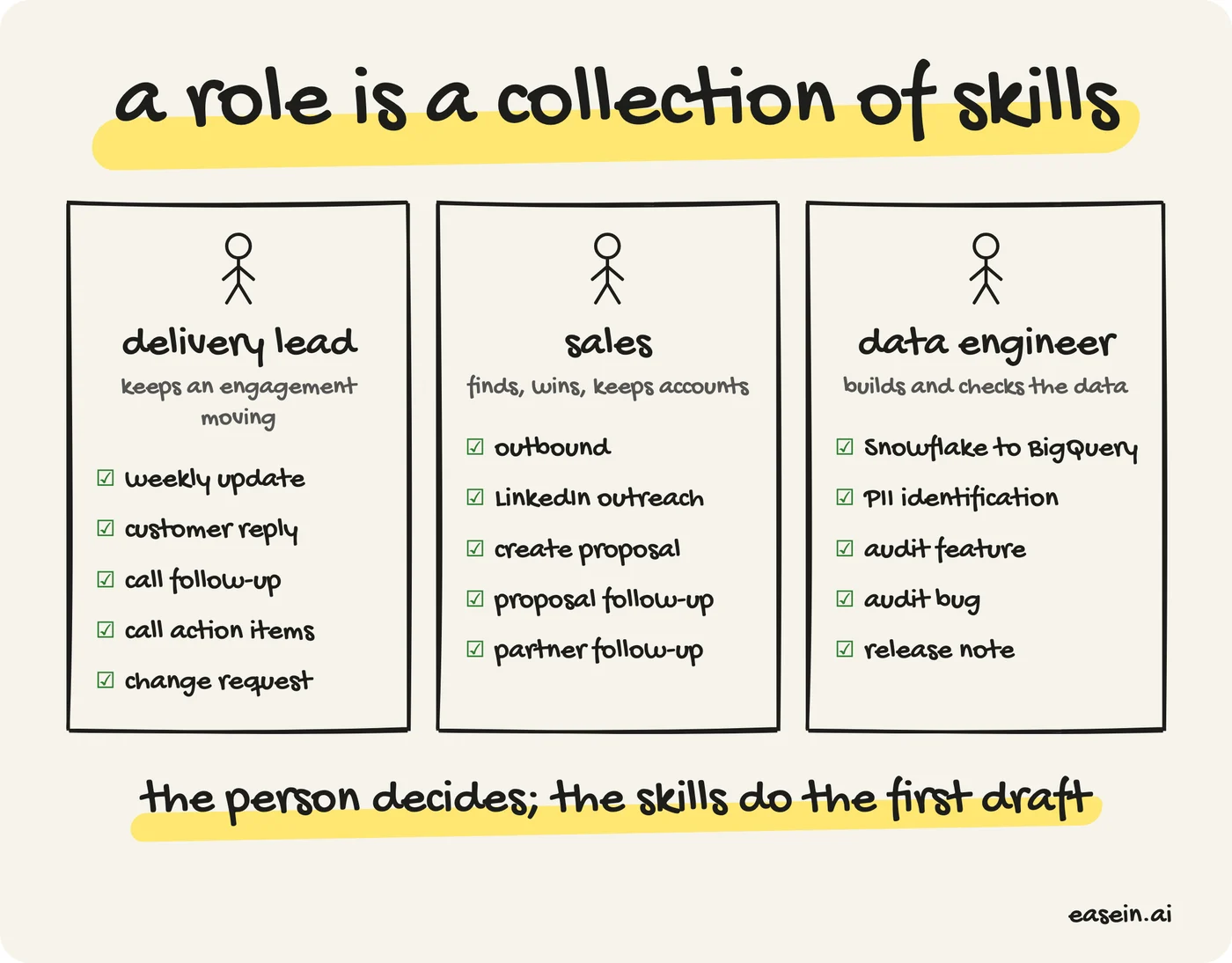
Take the delivery lead. Their week is the Friday update to each customer, replies to customer questions, the follow-up after each call, turning calls into tracked work, and a change request when the scope moves. Each of those is a job someone can write down once, which makes each one a skill. The lead still owns the relationship and decides what goes out; the skills mean the first draft of every job is waiting before they start. The same holds for the salesperson, the data engineer and most roles in a company.
The people closest to the work know which of their jobs repeat, which is why bottom up works. Give them time and permission to automate their own function.
Top down: the missing half
Bottom up on its own stalls in a predictable way. Skills get shared ad hoc, even inside one team. A workflow one person built often does not run for a colleague. There is no central place to find what exists, no check before a skill spreads, and no view of what gets used. People work in Claude, Copilot and Gemini side by side, so a skill written for one tool never reaches the people on another.
The top down half has three parts:
- A platform. Every skill in one place, organised by team, each with a page showing what it does, how to trigger it and who made it. Anyone can browse it, learn how to build a skill and submit their own. It grades every skill against one standard before it is published, and every new version again, and it counts how often each skill runs, by team and by person.
- The skills. Start with a few golden skills the company builds and vets itself, the ones nearly everyone needs: weekly goals, call follow-ups, company branding, weekly updates and replies to email. Then build out a library across your departments.
- Enablement. Training, a first skill that is easy to start, office hours, and a reason to keep going: recognition and rewards for the people whose skills others use.
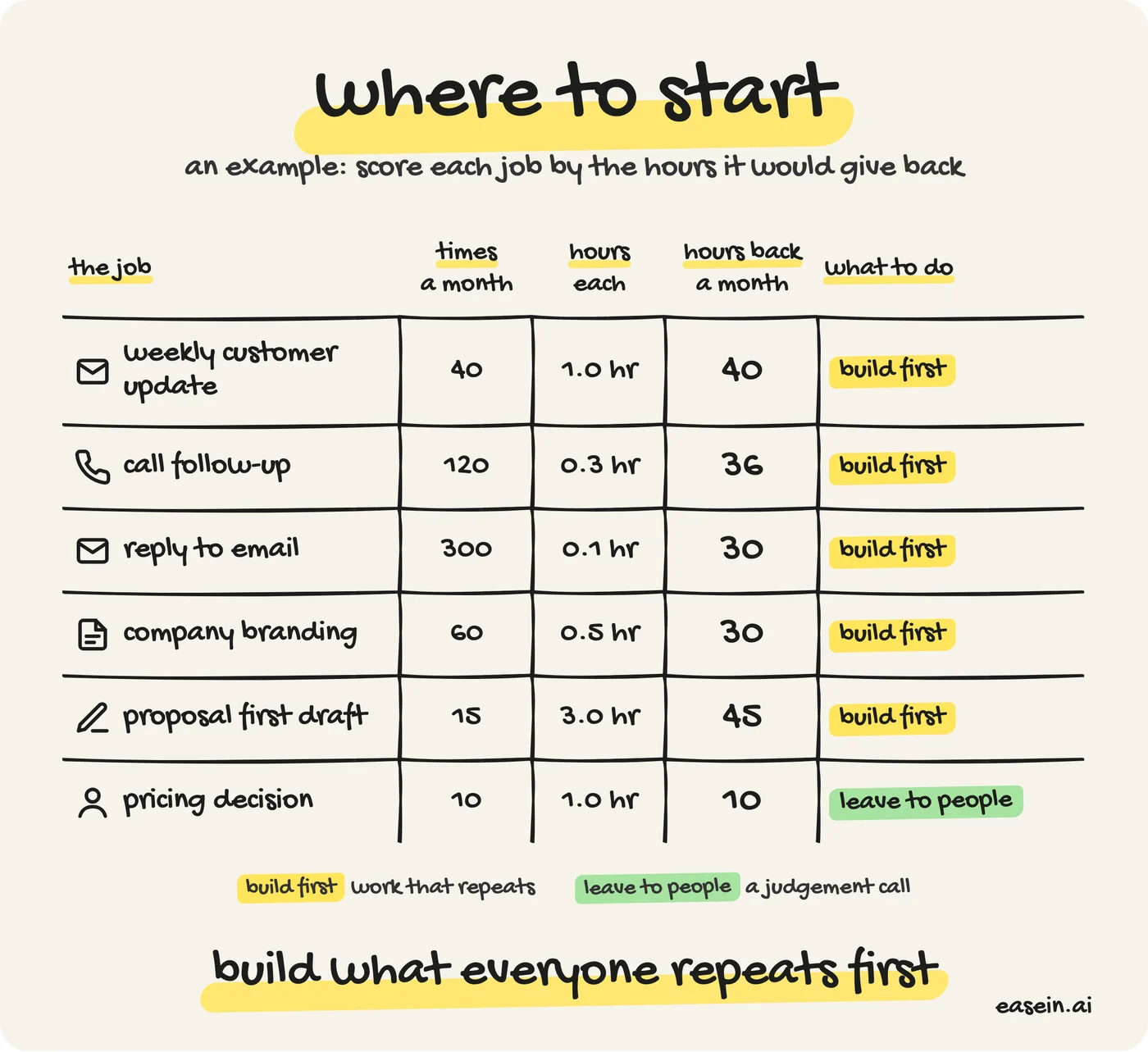
It works at speed when the company commits. Brainlabs, the marketing agency, built about 400 skills in four weeks and reached 91 percent adoption in North America, in a case study Anthropic published. The golden skills matter more than their number suggests. They are the worked examples people copy, so they set the bar for everything after them.
Why not use your model provider's marketplace
Every major provider now ships a skills library inside its enterprise product. As of October 2026, in short:
- Claude. Owners push a skill to everyone at once. Usage per skill only on Enterprise.
- ChatGPT. A workspace library of skills. Usage per skill only on Enterprise and Edu.
- Gemini. Admins switch skills on and can require approval. No usage per skill.
- Microsoft Copilot. People can call a skill with @ in Copilot Chat, but skills an admin pushes to the whole organisation only work in PowerPoint so far.
What none of them does is reach the people working in the other three.
None of them is the right home. Once people start building in a vendor's library they rarely move, so put something central in place on day one, for three reasons.
- You want to be provider agnostic. Your people use more than one tool, and the best model for a job changes every few months. A skill locked inside one vendor's library gets rebuilt for the next one. Your skills are how your company works, and that should not depend on which vendor you pay this year.
- You want to own your own intelligence. Your skills are your IP: how your company does its work, written down. Distribute them through these marketplaces, but host them yourself, so you decide which skills are on, which are off, and who gets each one.
- You want it personal, and you want to see it used. A marketplace knows a skill exists. Your own platform knows who joined on Monday, what their role is and which skills people in that role rely on, and recommends those first. Ramp built exactly this for itself: Glass, its internal AI workspace, has a library of skills colleagues built and a guide that recommends skills from each person's role and tools. Your own platform also sees who builds skills and whose skills others use, across every tool, so you can recognise it, rank it and pay for it.
What a good skill is
At its core a skill is the simplest version of an agent: a short description of when to use it, then step by step instructions in plain English. It can carry a script for the parts that have to be exact, but most are plain text. The AI already knows how to write, research and use your tools. What it does not know is how you do things, and that is all a skill contains.
Take a skill most client-facing teams could use: the Friday update to each customer, covering what happened last week, what is planned this week, and what is needed from the customer. These are the steps of a skill that drafts it:
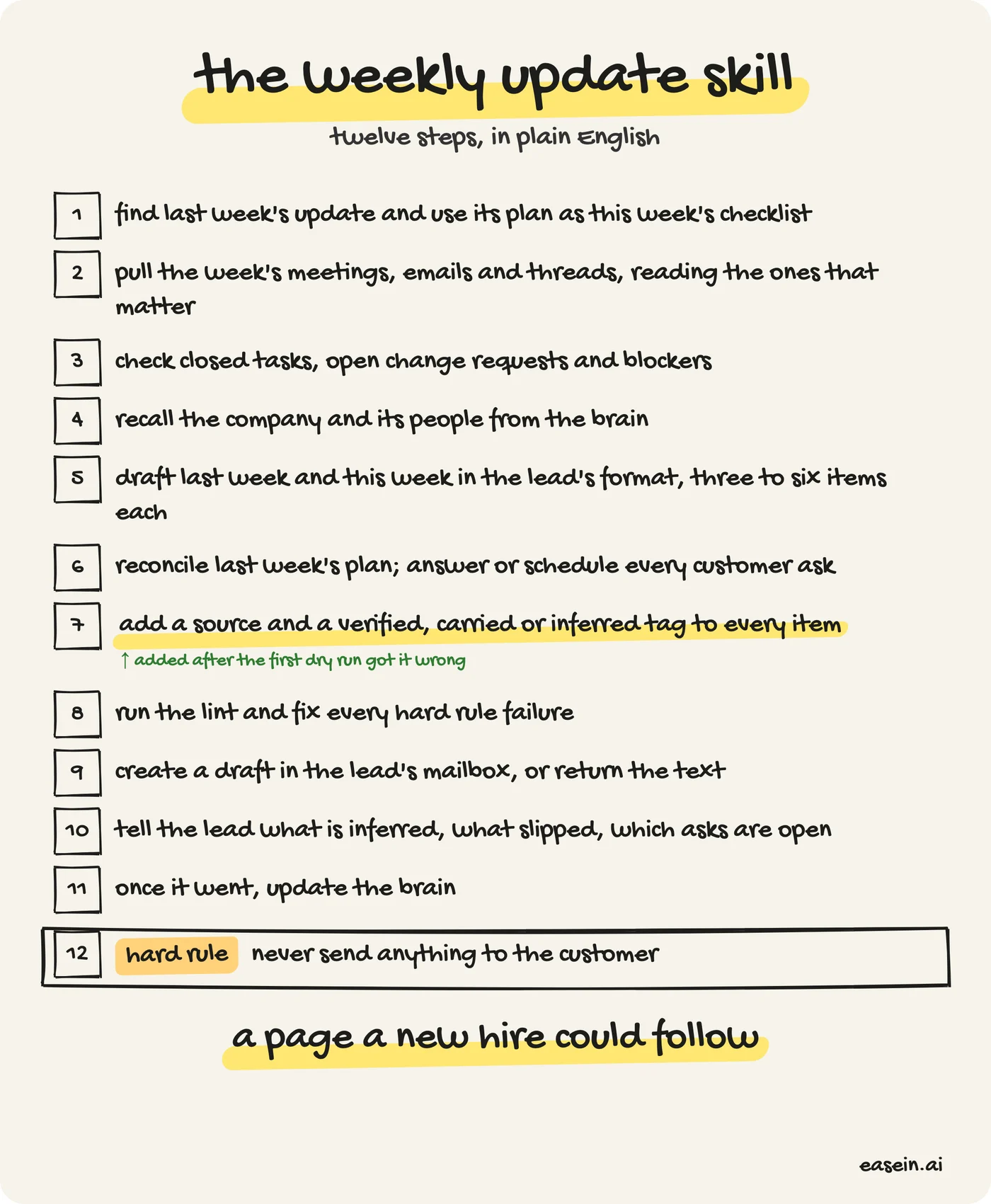
Read them the way a new hire would read a page of instructions from the person who did the job before them, because that is what they are. The good ones share four things:
- A description that says when to use it. The AI picks a skill by matching its description against what you asked for. "Draft the Friday weekly update for a customer engagement; use when asked for the weekly update, summary or report for a customer" is something a model can match.
- Steps a smart intern could follow. Name the sources, the order, the format and who signs off.
- Hard rules, written as rules. The few things that must never happen get their own list. This one never sends anything to a customer; a person does.
- Fix a mistake once. The first test run reported last week's plan as if all of it had happened. So step seven was added: every item now says where it came from and whether it was confirmed. Every run since has that fix built in.
Evals: making every version better
A skill changes every time someone edits it, and evals are how you know an edit made it better. This is the part most companies skip, and the reason their skills drift.
Every skill should carry a rubric: its goal, the dimensions it is graded on, and the failures that disqualify it outright. A branding skill, for example, would be graded on palette fidelity, logo and type, cover and contents, page layout and writing style.
To grade a version, the skill runs on a real case and three AI judges score the output, one model each from OpenAI, Anthropic and Google. Each judge scores every dimension from 1 to 10. A dimension passes with a mean of 7 and no judge below 5. The three providers matter: research from Cohere found that a panel of judges from different model families agreed with human ratings better than a single large judge, showed less bias toward its own family's outputs, and cost over seven times less.
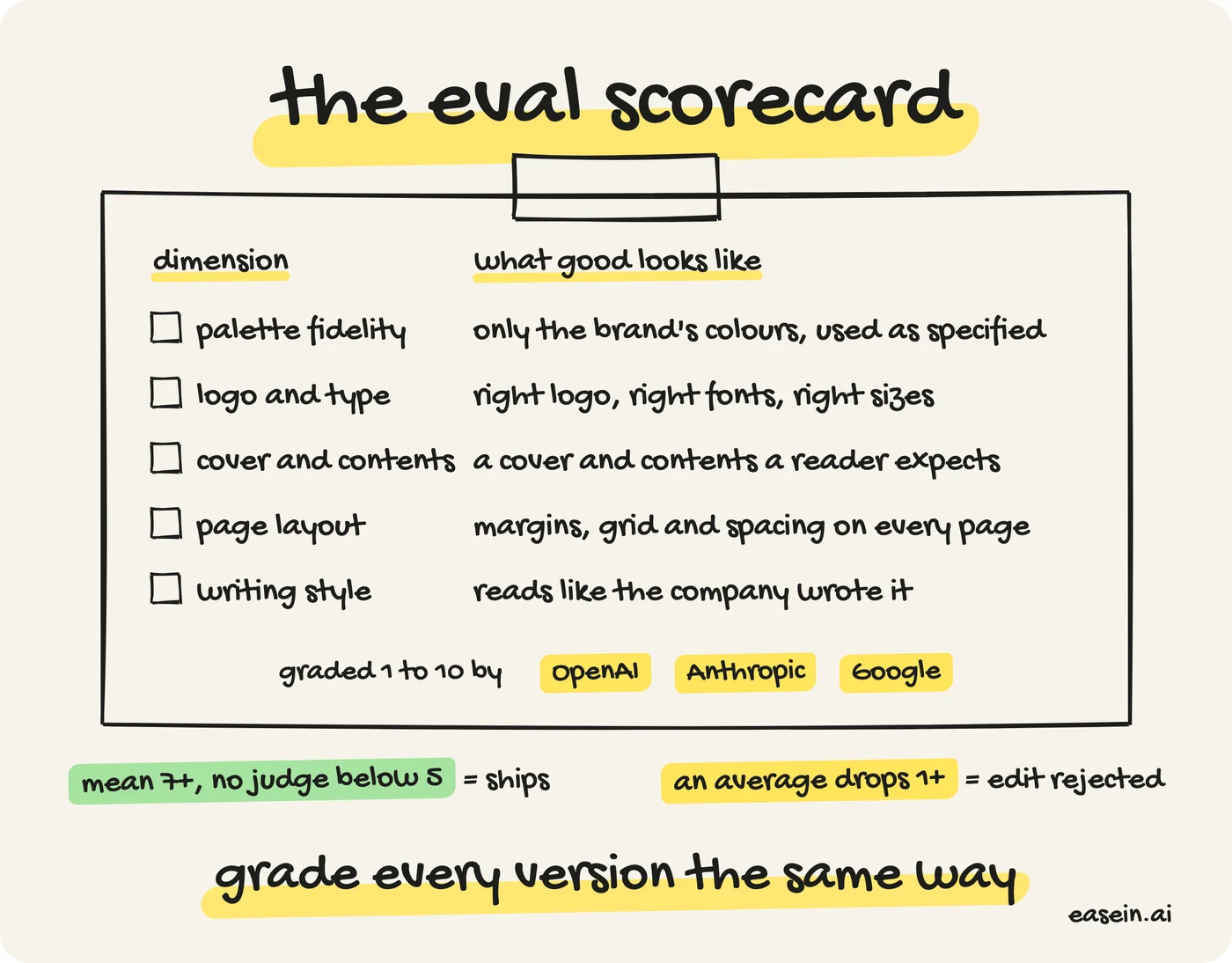
Two more rules keep quality up. Before the eval, an AI reviewer reads the skill and checks that it is safe, that the short list of steps people see matches what it actually does, and that it does not duplicate a skill you already have. And an edit cannot lower any score by more than a point, so a skill can only get better, never worse.
The author should see every score and the reason for it. A skill that scores 2s and 4s on its first try can reach 7s to 9s within a few, because each low score points at what to fix.
One repository, published everywhere, one usage hook
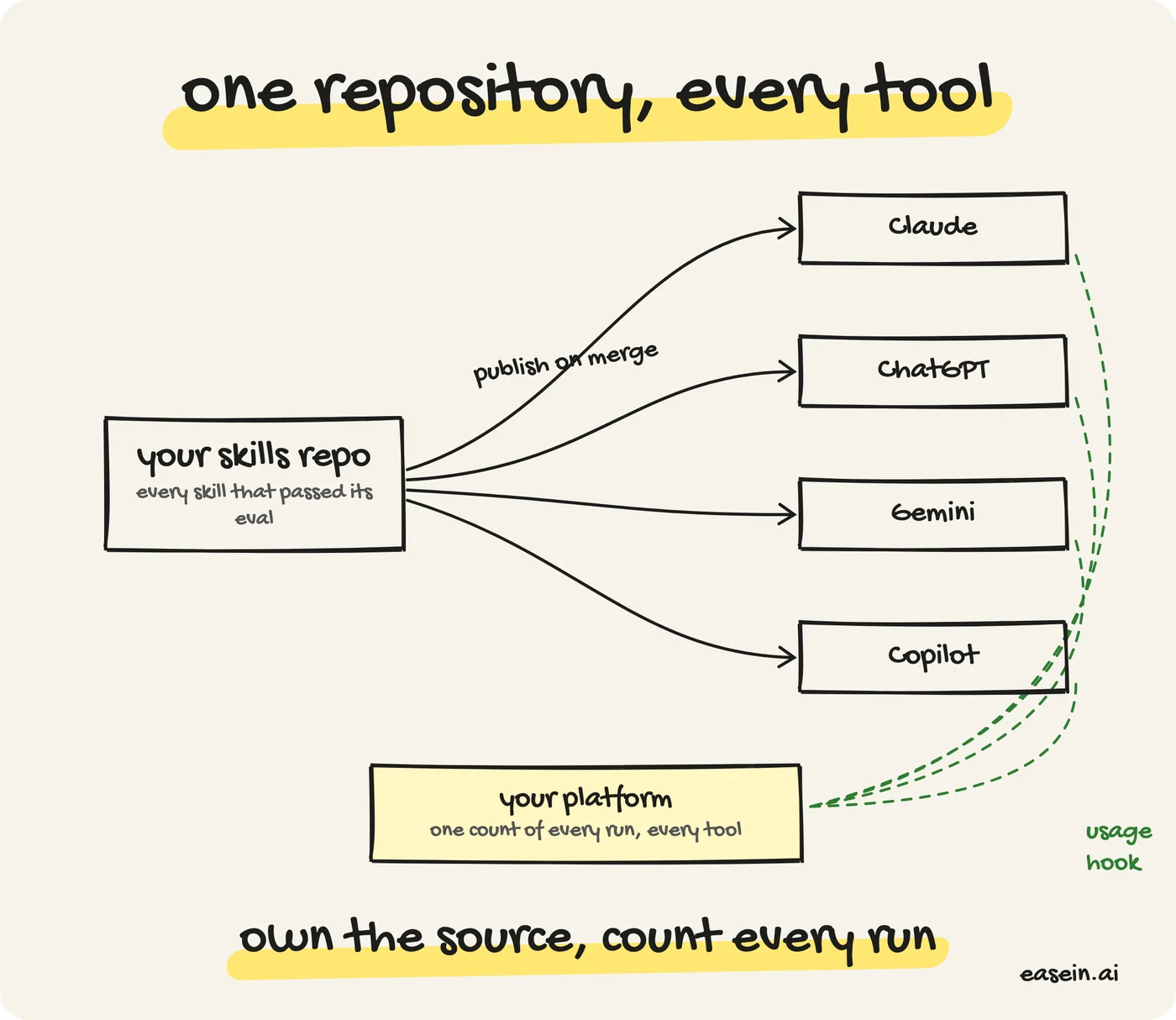
Your skills should live in one place you own: a git repository. When a skill merges there, it publishes to each tool from there, so the version in every tool is the version that passed the eval. Some tools, such as Claude Code and Codex, install skills straight from a repository. For the rest, the publish step produces the package each admin console expects.
Usage comes from hooks. A hook fires each time a skill runs and reports it to your own platform, so you get one count across every tool instead of a separate dashboard per vendor, where one exists at all.
Enablement: the hard part is people
Like every change in how people work, skills are a change in mindset, and people are the hardest part. Even with a platform built for it, most people do not start on their own. They started when someone handed them the first 80 percent: a working skill for their own job that they only had to correct. So make starting as easy as possible. Write the first skill for each role yourself, run workshops on what a skill is using your own company's examples, and hold weekly office hours where people bring the skill they are stuck on, starting with the power users who already have something to share. Then make the effort visible and rewarded, which is what the scoreboard further down is for.
How teiō uses skills
We've rolled out skills into our internal portal, so everyone in the company has access to them: 30+ skills for different departments today, and we expect to pass 100 by the end of the year. The platform runs some of them itself: release notes are written by the release note skill every time a change ships, and the audits that review every feature and bug fix are skills too.
Discovery
Our skills page works like an app store: search, a section per category, and a page for every skill with its steps in plain English, the phrases that trigger it, its creator, ratings and comments.
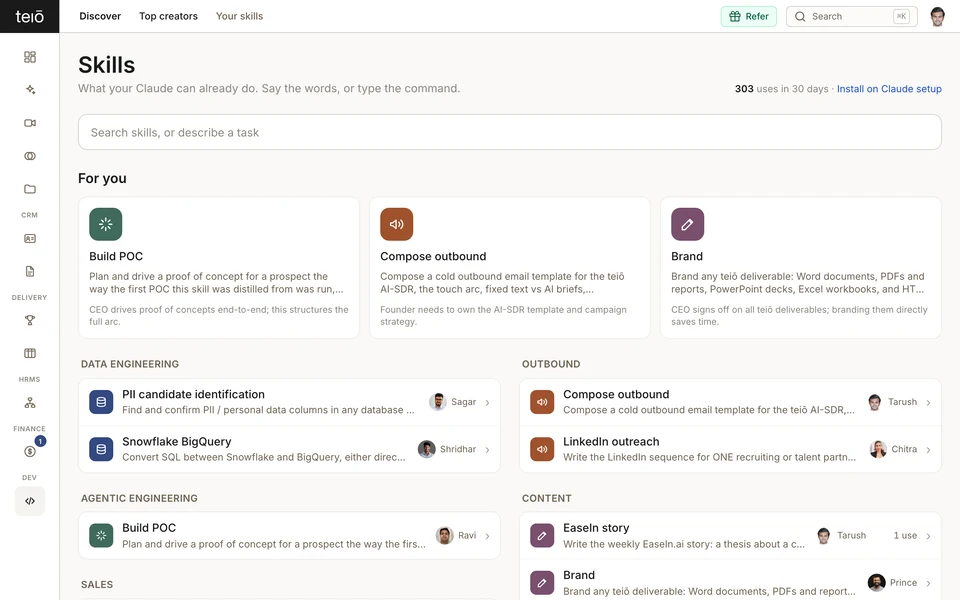
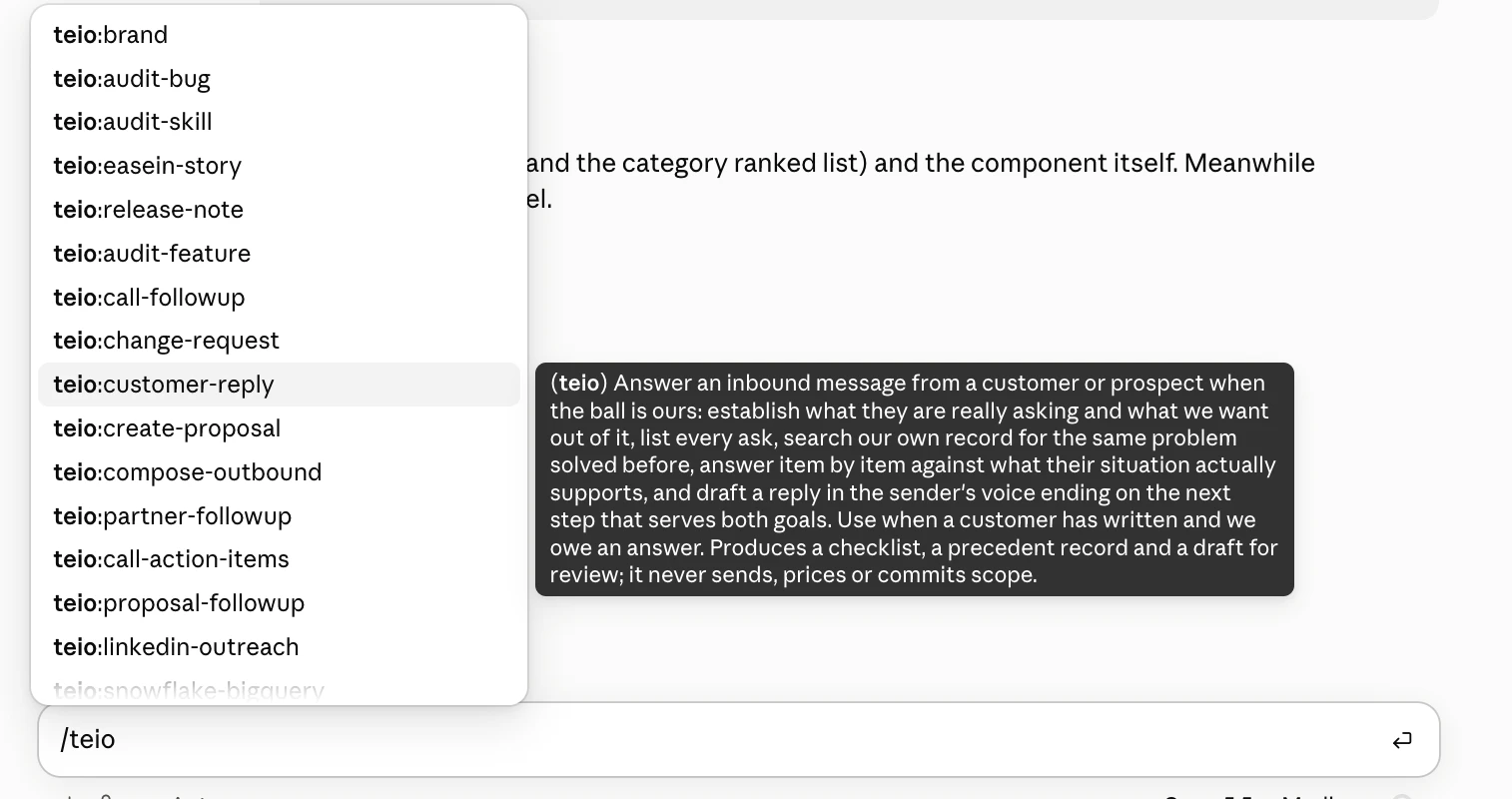
The For you row is how a new joiner finds their first skills. A model picks up to four for each person from their job title, what they have already run, and each skill's usage and rating. On day one the title does the work: a salesperson sees the proposal skills, an engineer sees the review ones. The skills are already on their machine from setup. Type /teio in Claude Code and every company skill is there:
Submissions
Anyone can submit a skill, and one that passes its checks merges with no person in the loop. A skill moves through five steps: submit, audit, a sample of real output, the eval, and merge. A failed step sends it back with the reason posted on the submission, and the next push starts it again from the audit.
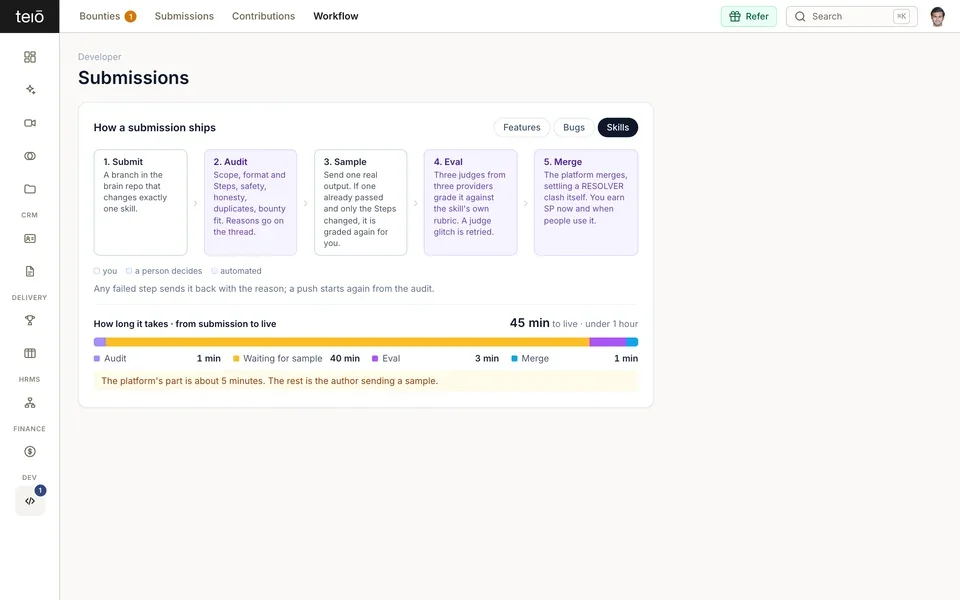
Once a skill is submitted it can be live in under an hour. The platform's part takes about five minutes; the rest is the author running the skill once to send a sample.
Gamification
Every skill page shows a face and a name, and a Top creators page ranks the people who made them by how much others use their skills and the points they have earned.
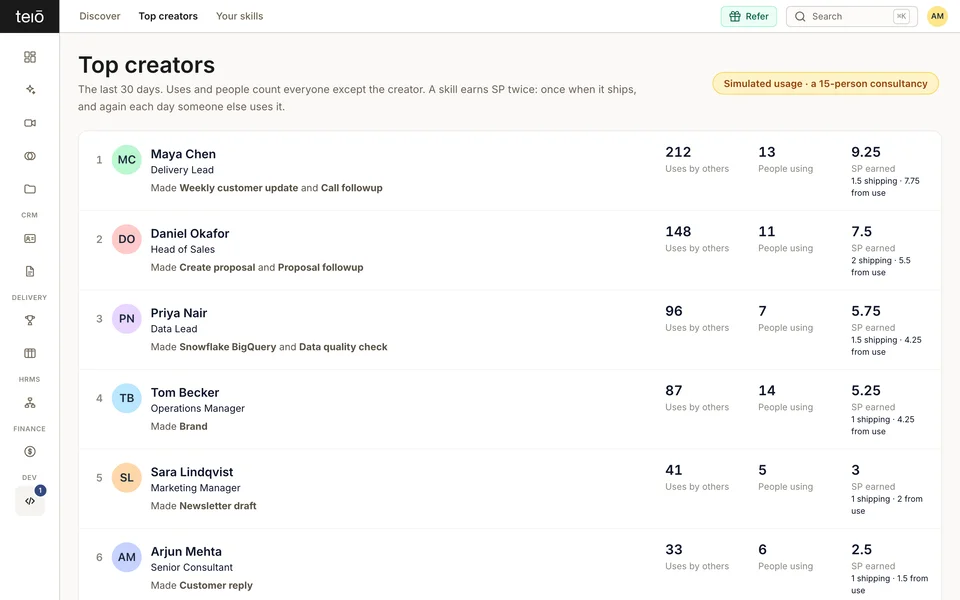
We track every run and turn it into points. A skill earns its creator points when it merges, and more each day a colleague uses it. Points are the unit we credit all work in, so they flow straight into incentive pay. Every month the top creator goes on our Wall of Fame.
The idea is simple. Someone who builds a great skill has automated part of the job for everyone else who does it, and they should be rewarded for that. If a role is a collection of skills, the people who write those skills are doing some of the most valuable work in the company, and the way we reward people has to change to match.
If you want to set this up in your own company, reach out.
Tarush
Replies
Replies are open to subscribers. Join free and you can post one on the next issue too.
About the author
Tarush Aggarwal
Tarush runs teiō, building enterprise superintelligence for traditional companies. He started out as the first data engineer at Salesforce in 2011, was a founding expert at the International Institute of Analytics and a columnist for Data Scientist, the first print data magazine, then global head of data at WeWork, and founder and CEO of 5X, voted on G2 as the #1 end-to-end data platform for SMBs.
Keep reading
How hedge funds are building a context layer around Excel
Why Excel, documents and email resist AI, how a hedge fund kept every spreadsheet and got a data platform anyway, and what becomes possible once the data sits underneath.
Build vs buy: How AI is changing how we think about managing risk
Why buying off the shelf was always a risk decision, what changes when building gets cheap, and the three ways of implementing AI in your organisation.
Going from trust to proof: How AI is changing operations
Why operations scale by hiring people to check people, how a photo now proves a class happened, and what automated itself once the records were clean.