How hedge funds are building a context layer around Excel

Tarush Aggarwal · August 2026 · 7 min
- Sector
- Hedge fund, public equities
- Region
- New York
- Company
- 15 to 20 people, $2bn+ AUM
- Before
- Hundreds of Excel models, no history
- After
- Every model read nightly, dated
- Unlocked
- Intelligence over Excel
TL;DR
Every company has a few tools nobody is ever going to give up. In finance it is Excel. In trade it is the document. Almost everywhere it is email. Telling a business team to stop using them is a losing argument, and it is usually the wrong one.
This fund runs its research on hundreds of Excel models. We did not touch them. A platform now reads every model on a schedule, keeps a dated copy of what each one said, and hands the numbers back into the cell the analyst was already working in.
When you work with traditional industries you run into tooling that was never built for the AI era. In finance today, that tool is Excel. The business was built on it over decades, and taking it away is impractical no matter what the technology can now do.
What comes out of that tooling is a file. The file sits on someone's drive, nothing else in the business can read it, and nothing anywhere records what went into it or what it said last Tuesday. That is fine until you want to ask a question that spans all of them at once, which is the entire point of AI.
So you have two options.
- Fight it. Best of luck convincing an analyst to give up Excel and move to something else.
- Work with it. This is our thesis. You leave the tool exactly where it is and build the context layer underneath it.
Why the spreadsheet earned its place
A spreadsheet model is a small program that encodes how one analyst thinks about one company. An inbox is where decisions actually get made. In each case the tool is the closest thing the business has to a source of truth, and it earned that position.
What none of them do is hand that truth to anything else. There is no API on a workbook. A file has no memory of the version before it. And when something fails inside one, it fails quietly, because a spreadsheet has no way to tell you a number is stale.
Some of these tools might get replaced in the AI era. But do you really want to wait for that? We think the best approach is to treat the workflow as fixed and put the intelligence around it.
Our case study: a New York hedge fund with over $2 billion under management
A hedge fund that takes concentrated positions in public companies and does deep fundamental research behind every one. A small firm, fifteen to twenty people.
Their research is hundreds of proprietary Excel models, one per company, each built by the analyst who covers it. That is the firm's edge and it took the better part of two decades to accumulate.
It also sat entirely in files. There was no way to compare an estimate across companies without opening workbooks and copying cells, and no record of what any model said a quarter ago. Market data was pulled straight into the individual workbooks, so a failed refresh would fall back to the last number it had and keep going. Nobody found out until someone happened to look.
What we built instead
A platform that sits under the models rather than in front of them. Analysts work in Excel exactly as before. The platform reads their work on a schedule, keeps the history, and gives it back to them in the same place they were already working.
Use case one: A data platform built around the spreadsheet
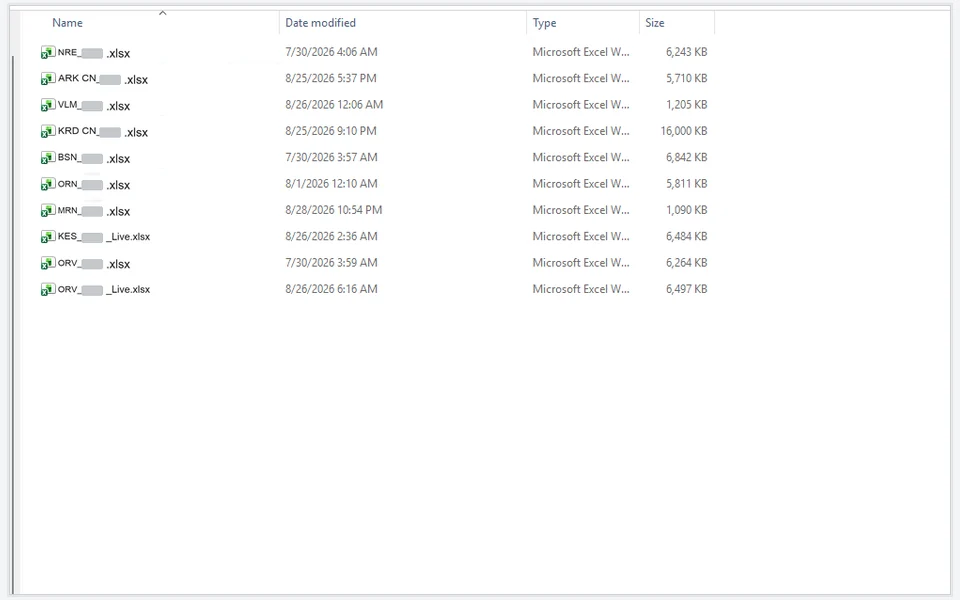
An analyst saves a model to the shared drive and adds a short config file that says how to run it. The model itself follows the same layout as every other one. That is the whole of what changed for them.
From there the platform picks it up and works out how to run it. Every night it opens each one, runs it through its scenarios, and writes the results out with the date attached.
Two things follow that were not possible before. Every model now has a history, so you can see what an analyst thought in June and what changed by August. And every model is readable by something other than Excel, which is what makes everything after this possible.
Reading every model the same way on the same night also means validating every one of them, and that surfaces problems nobody knew were there. Models pointing at supporting files that had moved, quietly building their numbers on stale links. The report groups the breakages by the file that has to be fixed and orders them by how many models each fix unblocks.
None of that was visible while the work lived in separate files on separate drives.
Every screen below runs on data we generated for the article. Names, tickers and figures are invented, and no customer data appears anywhere in it.
Use case two: Putting the intelligence back in the cell
A platform an analyst cannot reach from Excel is a platform an analyst will not use.
So the data goes back the way it came. An analyst types a function into a cell and gets the number, and behind that one function sits everything the platform holds: the firm's own estimates, market data, and any figure as of a particular date. They no longer wire vendor codes into their workbook, and they can see where each number came from and when it was captured.
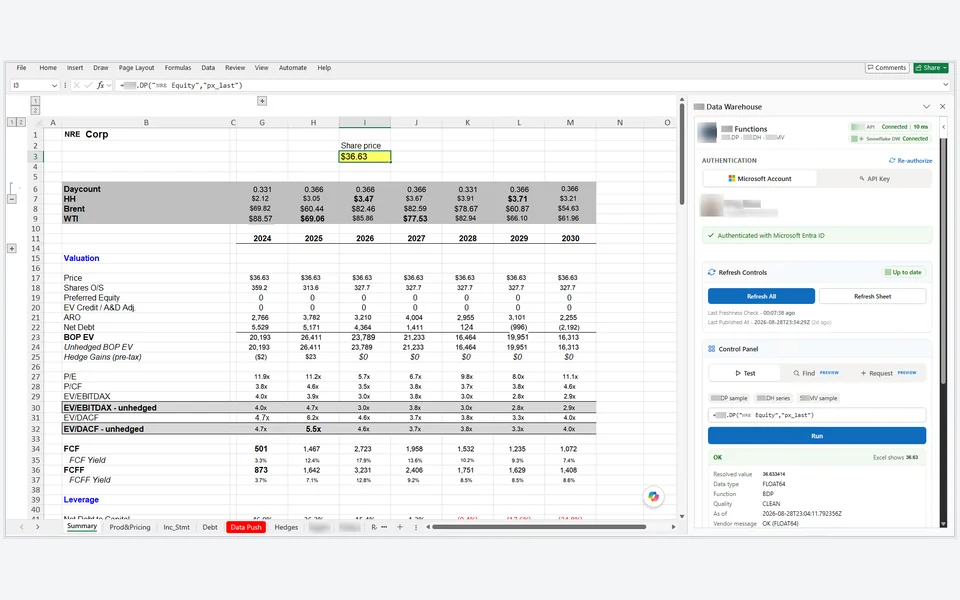
This is the step that makes the whole thing stick. The analyst gets a better spreadsheet, which is the only outcome they asked for. Everyone else gets a queryable copy of the firm's research, which is the outcome that matters to the rest of the business.
Use case three: Intelligence on top
This part is being built now.
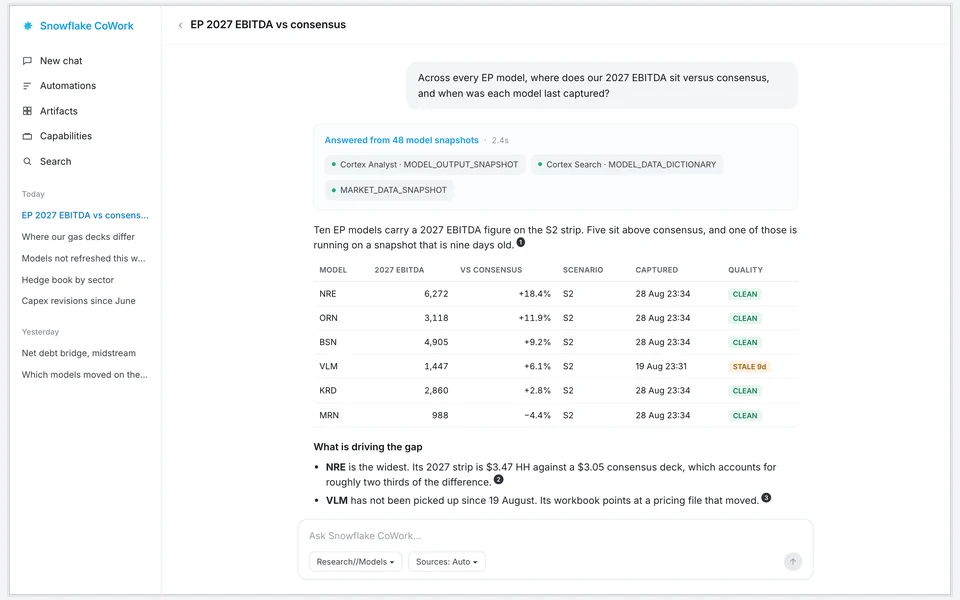
Once the research is readable, questions stop needing a person to go and open files. The work underway is a conversational layer over the whole dataset, so an analyst can ask across every model at once and get an answer that carries its own provenance: which scenario, which definition, when the data was captured, and a flag if anything was stale.
It reads what the models already write out, so it can answer wherever the question gets asked. In the warehouse for an analyst interrogating the data, in Slack for everyone who only wants the morning brief, and over MCP for whatever agent someone points at it. Agents come after that, running on the same layer. A morning brief on where the book is exposed, a monitor watching the names nobody has time to watch continuously, a tracker on how the firm's own view of a company has moved over months. Each one puts the right information in front of the right person sooner. The intelligence follows the person instead of the person going to find it.
How you do this yourself
The analysts at this fund still open Excel every morning. Nobody was retrained and no models were rewritten.
If you want to do something similar, here is the playbook.
- Put the files somewhere you can reach them.
- Agree a standard format they can be validated against.
- Schedule a nightly run that opens each one, pulls the core data out, and writes it into a warehouse for what is structured and blob storage for what is not. Link the two.
That gives the files structure and history, which is what the AI is built on.
That is the pattern worth taking from this, and it applies anywhere a business runs on a tool that predates all of this. Understand the workflow well enough and you can build around it, which gets you the tool people already trust with the intelligence layered on top.
FAQ
Do the analysts have to change how they build models?
They add a small amount of structure to each model and save it to a shared drive. They keep working in Excel. What changed is that a broken link now gets caught the same day instead of surviving for years.
Why not move off Excel eventually?
Excel is very good at what it does, and it is wired into the industry around it. Decades of plugins, a workforce already trained on it, and everyone you deal with using the same thing. Something may eventually replace that, but working with what already works is more practical than reinventing it.
You carry on with Excel, so the analysts get what they want, and the same data becomes available to AI.
What happens when the platform and the model disagree?
Nothing resolves itself. The disagreement raises an alert and goes to a person. The report shows which metric, which period, what each side produced, and the calculation behind the figure that was pulled, so the analyst who owns that model can trace how the number got there and decide what happens next.
Where else does this work?
Anywhere a lot of the work comes out as files. Corporate FP&A, insurance pricing, project finance, legal contract review. These are places where the work has lived in files for years and the people doing it are not going to stop, so you support that and let what is inside the files feed something wider.
If your spreadsheets are only reports over a database you already have, you have an easier problem.
If you want a deeper look at any of this, reach out.
Tarush
Replies
Replies are open to subscribers. Join free and you can post one on the next issue too.
About the author
Tarush Aggarwal
Tarush runs teiō, building enterprise superintelligence for traditional companies. He started out as the first data engineer at Salesforce in 2011, was a founding expert at the International Institute of Analytics and a columnist for Data Scientist, the first print data magazine, then global head of data at WeWork, and founder and CEO of 5X, voted on G2 as the #1 end-to-end data platform for SMBs.
Keep reading
Build vs buy: How AI is changing how we think about managing risk
Why buying off the shelf was always a risk decision, what changes when building gets cheap, and the three ways of implementing AI in your organisation.
Going from trust to proof: How AI is changing operations
Why operations scale by hiring people to check people, how a photo now proves a class happened, and what automated itself once the records were clean.
Going from centralized to hybrid: How teiō uses AI part III
Why we stopped building the OS centrally, how business teams now ship their own branches, and when to make the switch.