Own your intelligence: from fragmented tools to a central platform

Tarush Aggarwal · Updated November 2026 · 10 min
In July I wrote Context is king, about the platform we built to run teiō. A lot has changed since. This is an update on how we use AI today, and on what we're doing next: helping other companies build their own.
How teiō uses AI today
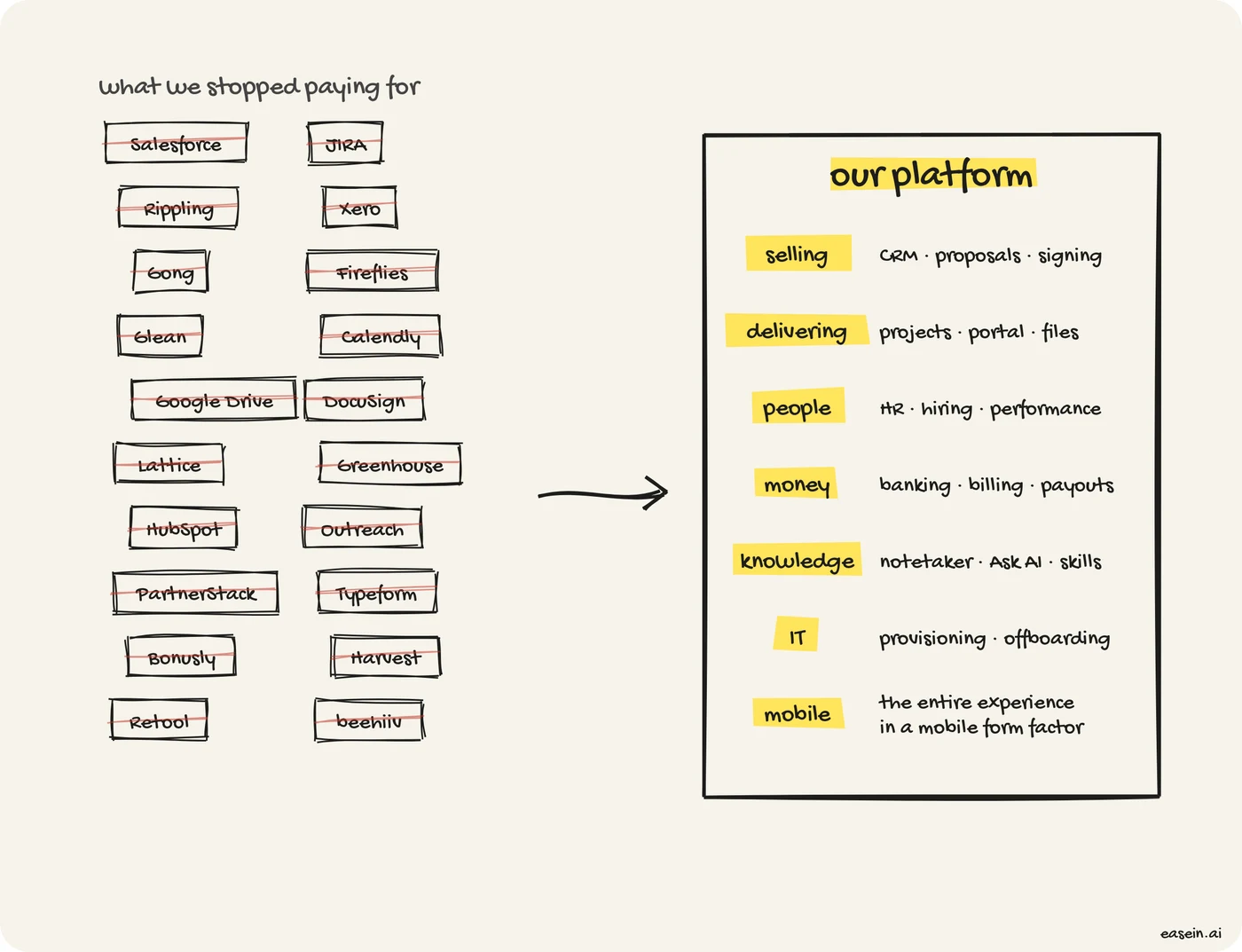
Context is king was a tour of ten modules. No Salesforce, no Notion, no Workday, no Rippling. The argument was that everyone has the same models, so the only edge left is context, and the fastest way to get context was either to build a layer on top of all your systems or to own the system all of your work runs in. That still holds. Four months later the system is over 25 tools, it's on my phone, and the way we build on it has changed more than the system itself.
Our development speed
- February 2026: 130 PRs/month
- April 2026: 240 PRs/month
- July 2026: 350 PRs/month
- October 2026: 700 PRs/month
Since we got started, our development speed has only gone up. With roughly the same team size, we now ship 5x more each month than we did when we started.
25 tools, one system
We still run the whole business on our own platform. These are the tools we stopped paying for, and what replaced them:
Agents on the team
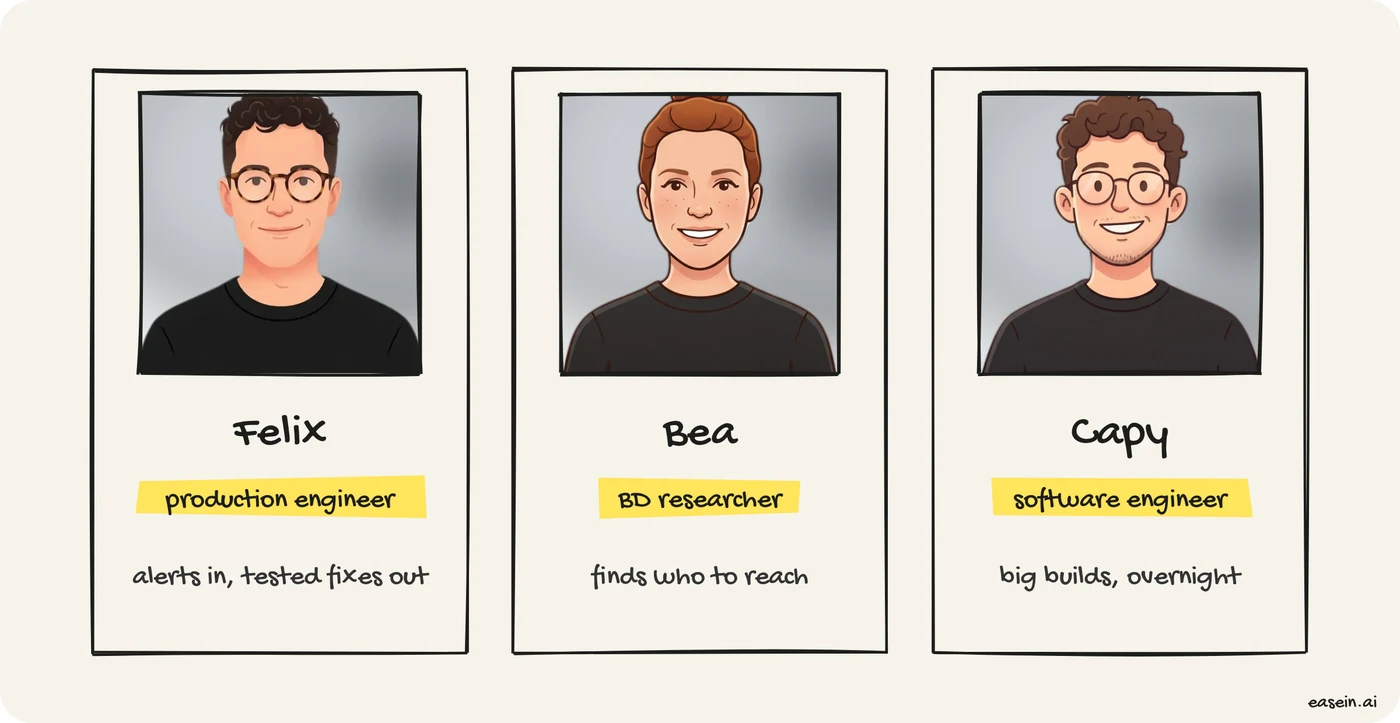
With everything on one platform, more signal comes in than people can act on. So we launched agents that act on our behalf, each one where people had become the bottleneck:
- Felix, production engineer. We ship so much code that alerts and bugs arrive faster than anyone can read them. Every alert and failed check goes to Felix: he reads the logs, finds the cause and writes the fix with a test that proves it. 70% of his fixes merge automatically; only the 30% that need human eyes come through us.
- Capy, software engineer. The platform is now extensive, with its own best practices and frameworks. Capy is trained on how we build, and he works far more on his own than a comparable setup in Claude Code, so a large build can make real headway in a single night.
- Bea, business development. We have the context of every use case we've built, industry by industry. Bea uses it to find similar companies, map each one's org chart, find the pain points of the people who matter, and use second-degree connections in our network to recommend the best way into the company. Then she carries it out.
This is just the start. We have a handful more agents in the pipeline, among them performance, helping each person on the team level up, and content, taking our best use cases to our audience. Sometime in Q1 we will have more agents than people on the team.
Each agent has its own identity on the platform, like anyone else on the team.
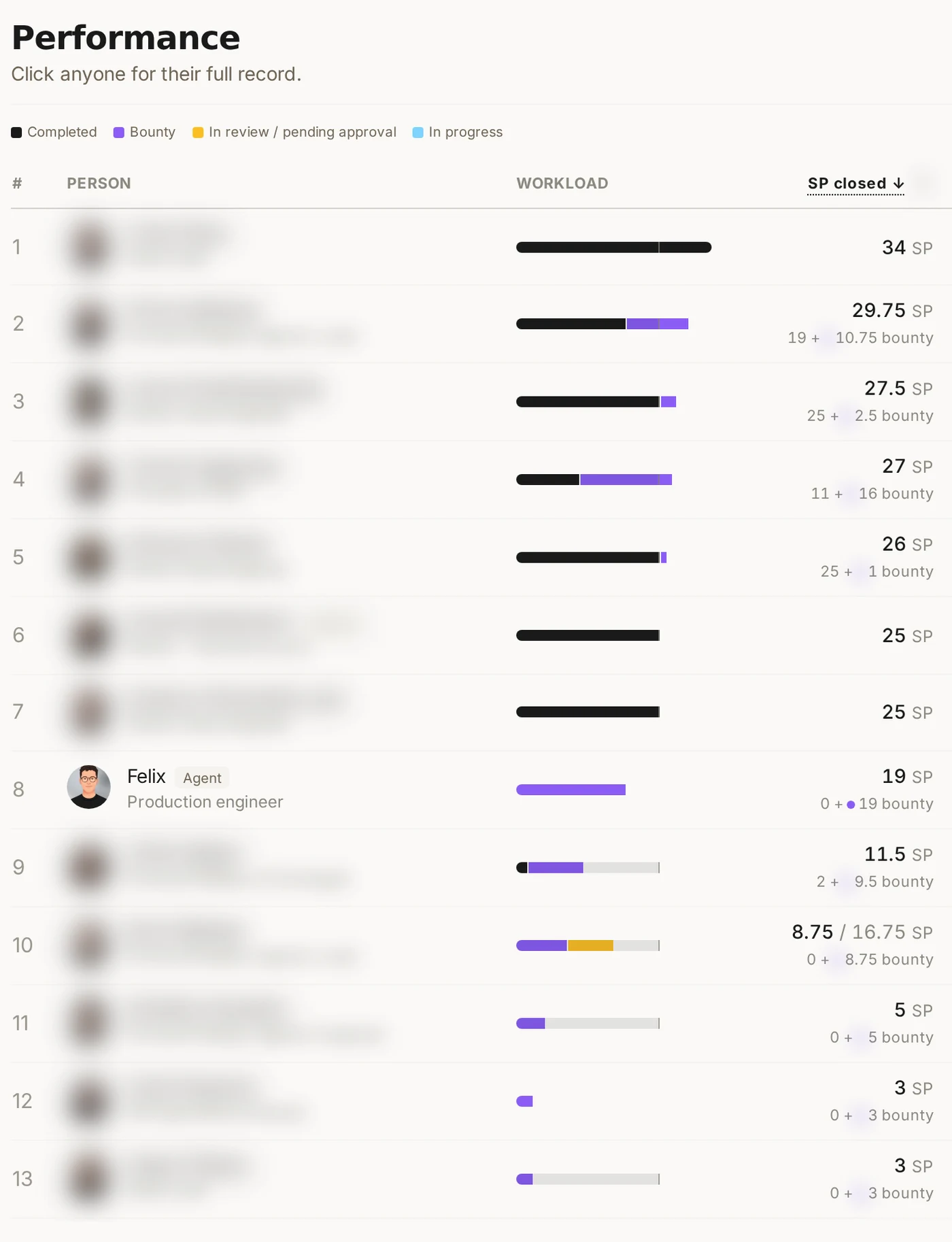
Because teiō measures outcomes, agents sit on the same leaderboard as everyone else. They are already in the middle of the pack: Felix finished 8th of 15 in October. Within a quarter we expect agents in the 90th percentile of output, behind only our top performers.
Three use cases we never planned
We never planned these. They are second-order consequences of all the signal the platform produces once you solve fragmentation and start to centralize everything.
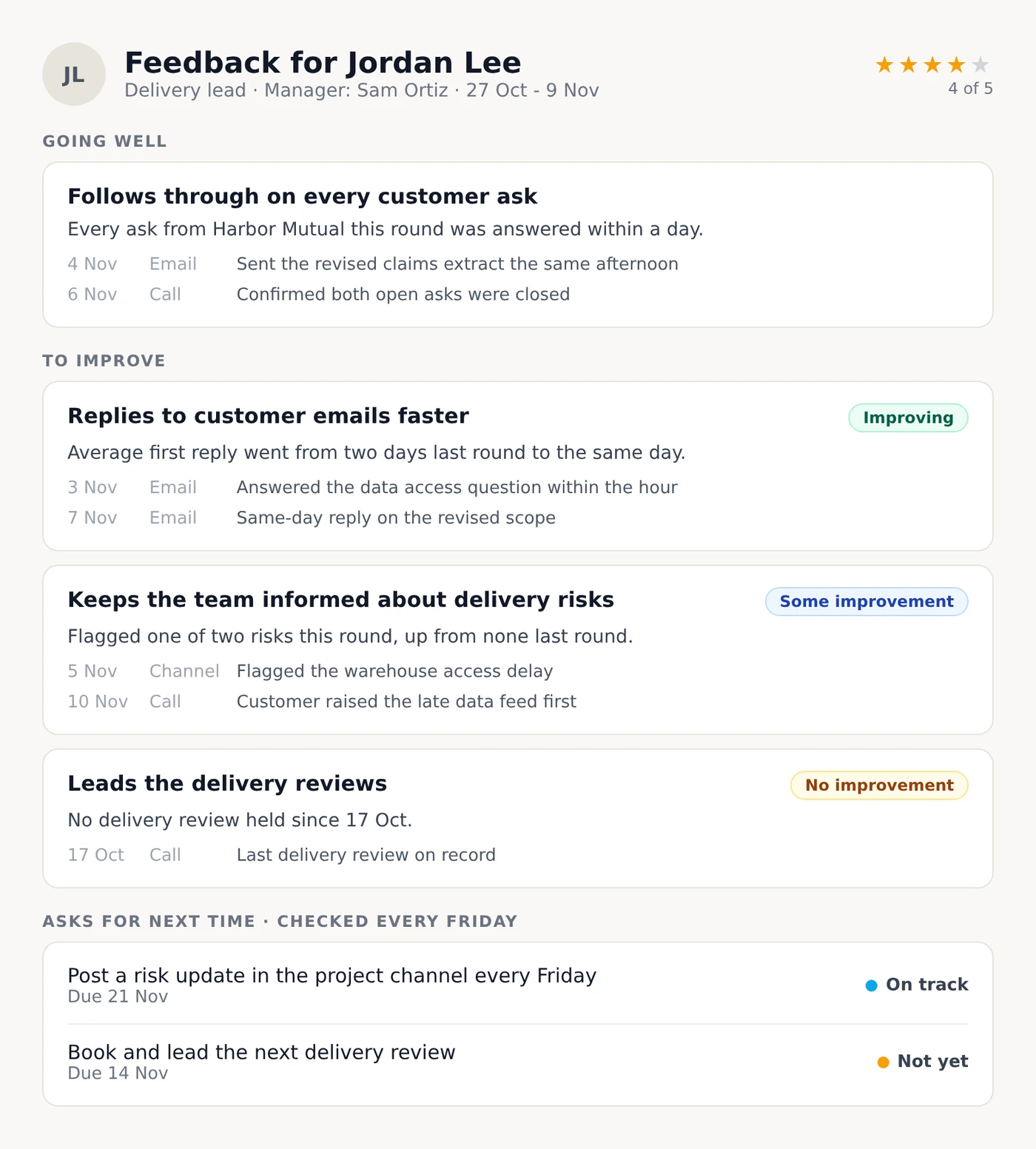
Real-time performance feedback for the team. We expect every manager to give feedback to each person on their team. The platform reads that feedback, then looks through the work behind it (email, call notes, meetings with customers, tasks and submissions) to understand it and validate it. It reads only what is customer or team facing; we don't snoop. Then it tracks how the person is doing on that feedback every week, to help them improve. By the next round, nobody has to remember whether someone got better: it's all tracked, and we can see the progress.
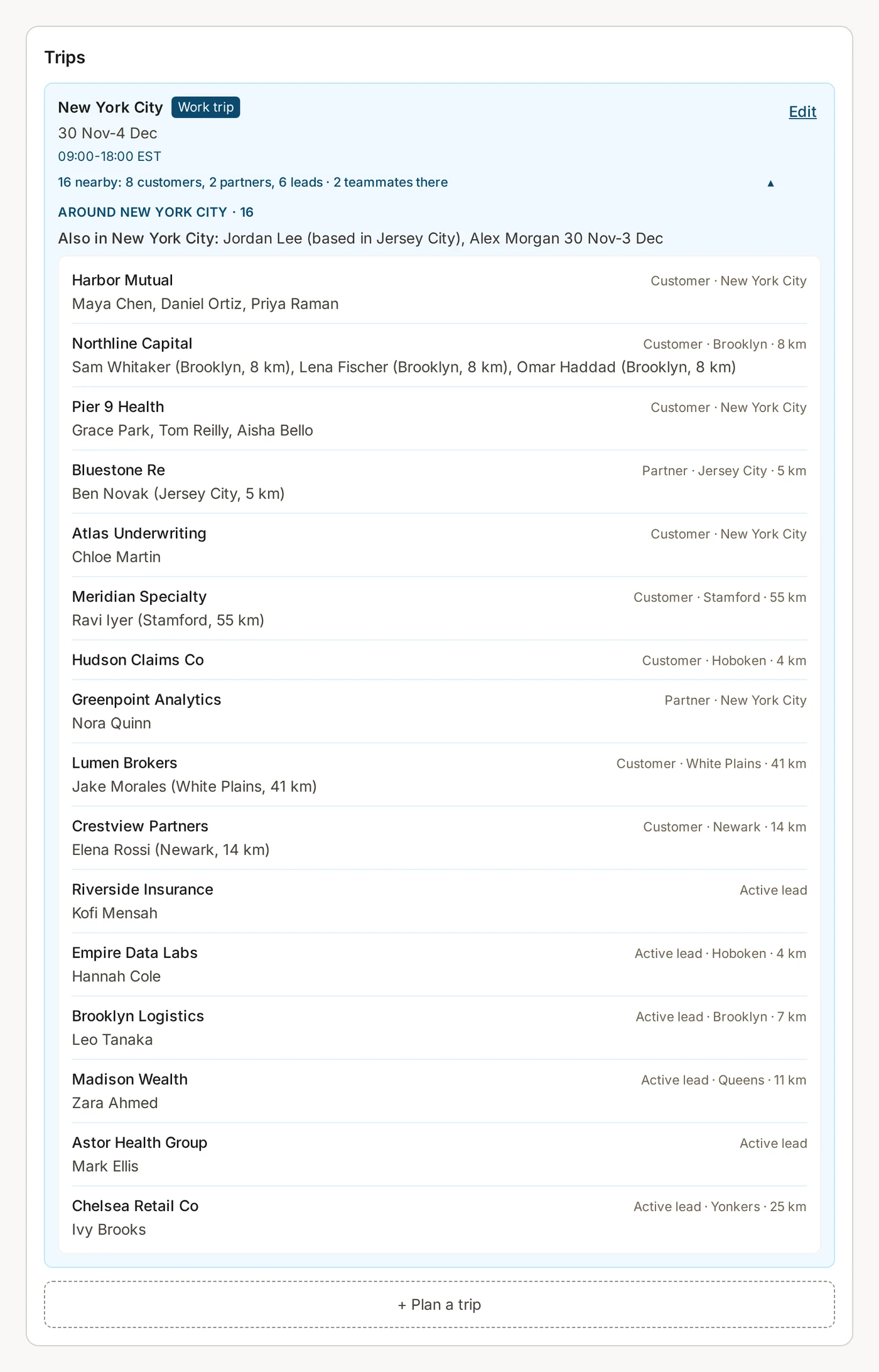
Using availability data to bring people together in person. Between prospects, partners, customers and teammates, and a team that works remotely, it's hard to keep track of who is where. While building our own availability tool, our replacement for Calendly, we started tracking where people are, to get time zones right. A by-product is that a trip now shows who is nearby: plan a trip to New York and it lists the customers, prospects and partners within 100 km, with the person to meet at each, plus which teammates will be in town the same days. Those are the meetings you would never think to set up: the partner you last spoke to in the spring, the prospect whose office is twenty minutes away, the teammate you have only ever seen on video. The whole platform now works to bring people together in person whenever they're going to be close.
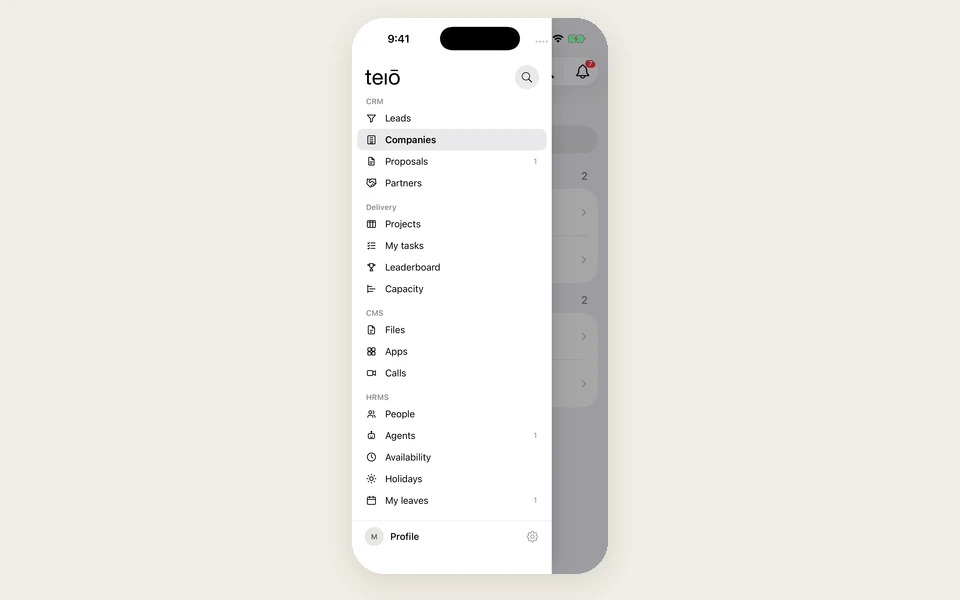
teiō in a mobile form factor. Not a light version of the web app: the full experience, built natively for a mobile form factor, so you stay connected on the go. Approve a change request, read a call, check the bank, ask a question. This is enterprise superintelligence: all of your context, optimized for your form factor.
Why a central platform
Most companies run on dozens of tools, and that fragments three things:
- Tooling: every team buys its own, each with its own login, its own copy of the customer and its own permissions.
- Workflows: signing a customer runs across a CRM, a proposal tool, a signing tool and an invoicing tool, and only people carry it from one to the next.
- Context: the call is in the notetaker, the agreement in email, the delivery in the tracker.
Together they fragment the company's intelligence. No person, and no AI, can see how the business actually works.
The antidote is a central platform, which centralizes the same three things:
- Data sets: one customer, one person, one project, one ledger, the same record everywhere.
- Workflows and applications: the CRM, delivery, hiring, banking and the rest built on one foundation, so a piece of work moves from one to the next by itself.
- Context: the judgment in between: connecting data sets and applications, and making sense of the data in the terms people actually use.
And it runs everywhere: on the web, in a mobile form factor, inside Claude and ChatGPT, and in any other application that can use the same context.
Agents are a buzzword, but if you want agents that are really good, they need all three. You can get good context from the data sets alone, but if you want agents to take action, you need to centralize the workflows and applications as well.
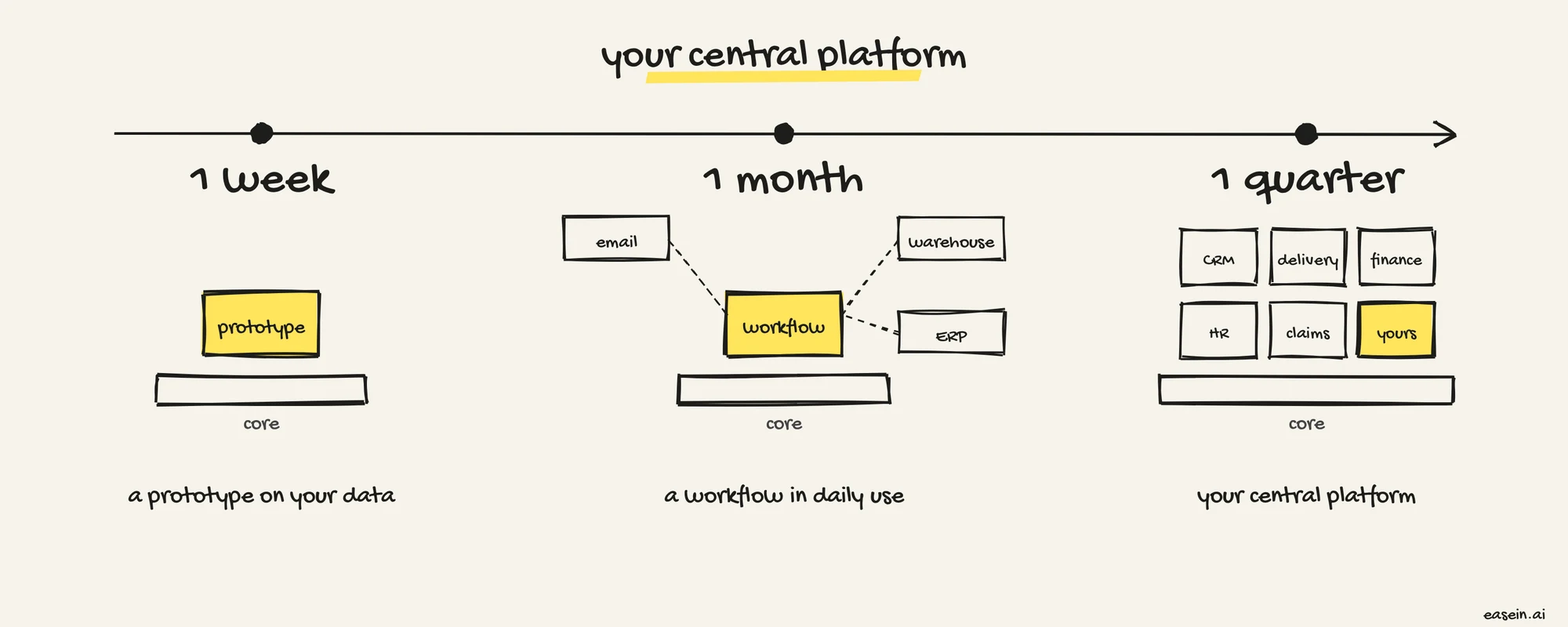
A new model for building your central platform
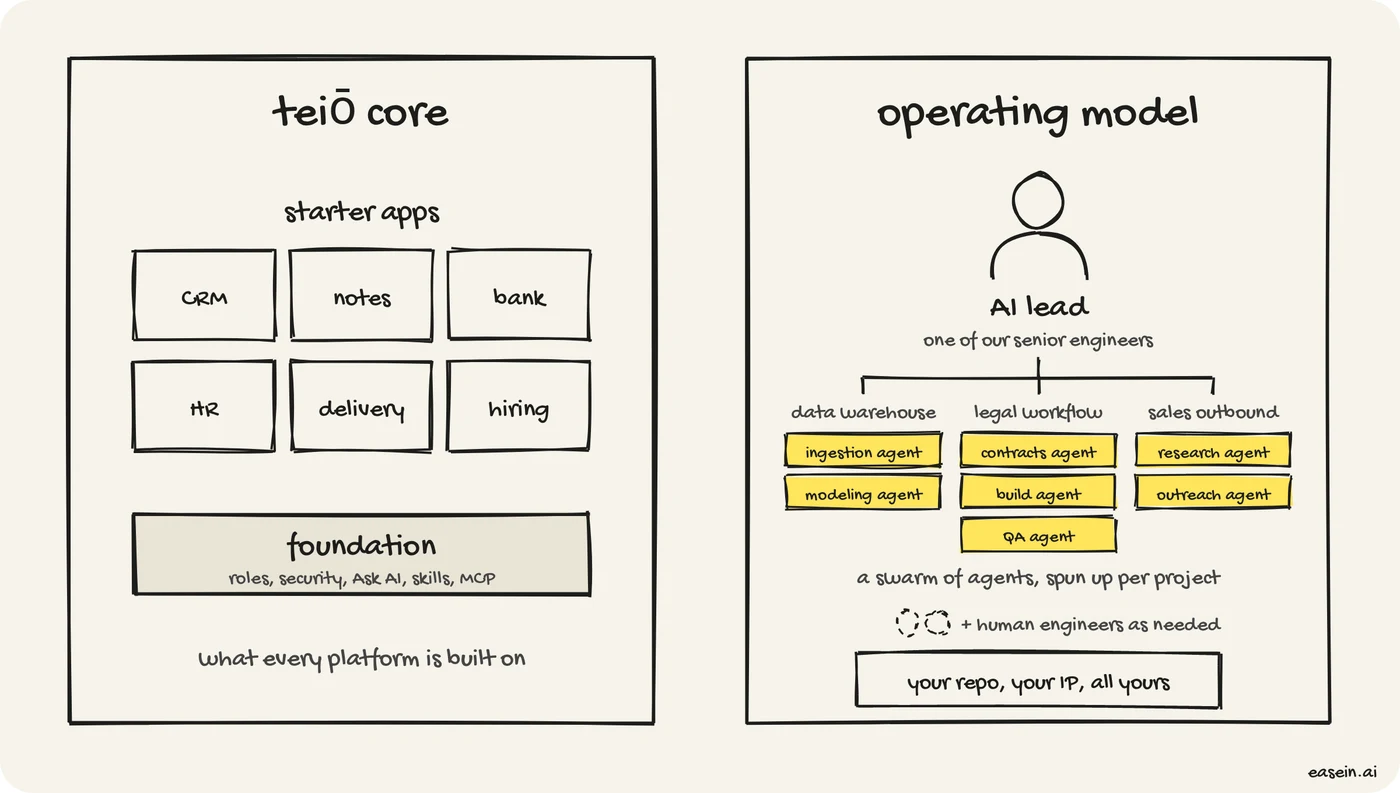
We're excited to introduce a new model for helping companies build their own central platform. It has two pieces: the foundation, which we call teiō core, and the operating model.
teiō core
SaaS sold every company in an industry the same 80%. AI flips that. Building is now cheap enough that only about 20% should be shared, and the rest should look like your company. teiō core is that 20%, with templates to quickly build the other 80%. It comes in two parts:
- The foundation: sign-in, roles and permissions, security and audit logs, Ask AI, skills, agents, notifications, the MCP server and the build process.
- Starter apps: every app we build for ourselves (CRM, notetaker, banking, delivery, HR, hiring, performance and more), ready to copy in and make your own.
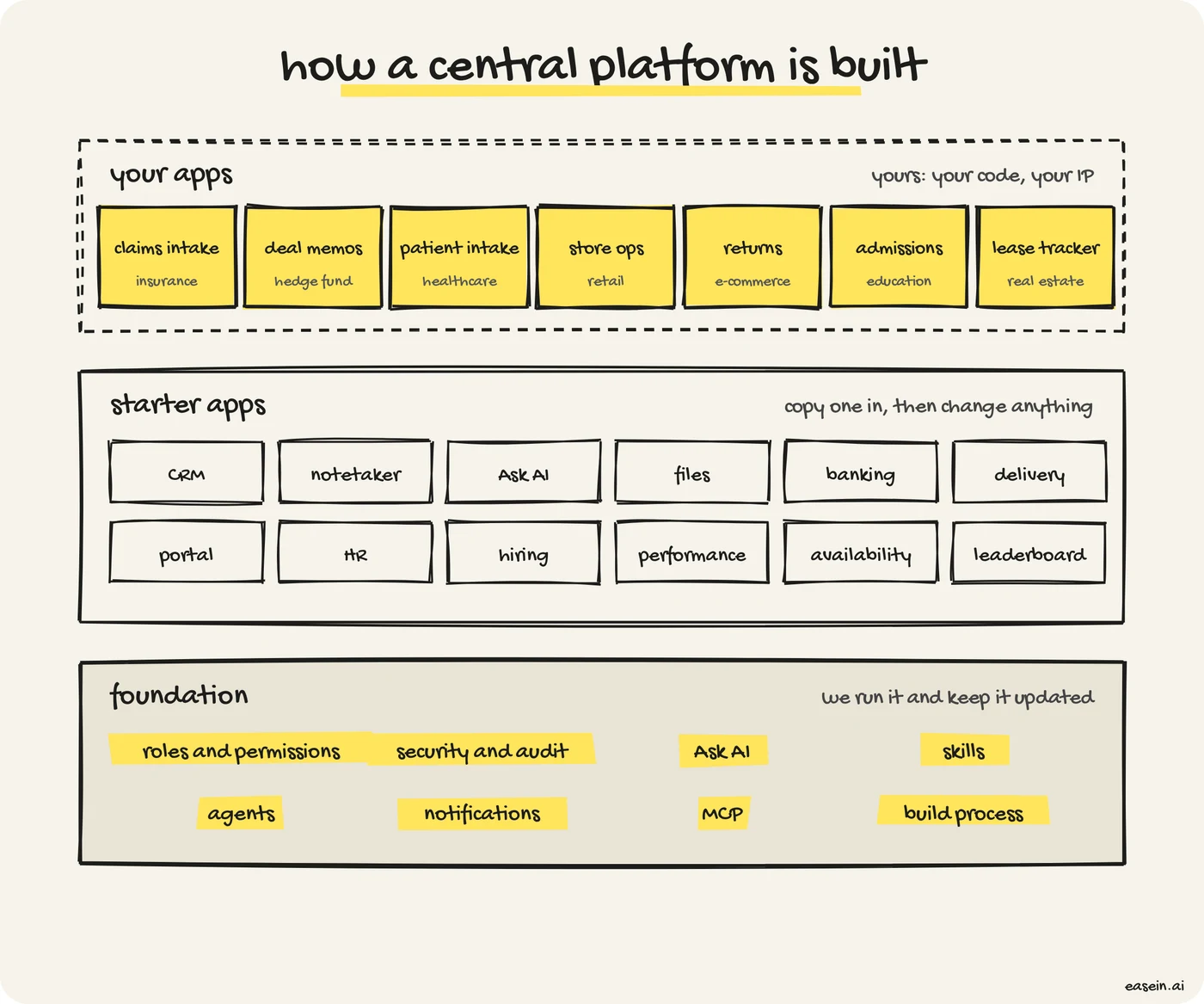
We maintain core and keep improving it. You build your apps on top, so every update makes your platform better without touching your work. It runs in your own cloud, next to your data. Every customer starts on the same core and ends up nothing alike.
The operating model: forward deployed AI pods
When teiō got started, we used output-based pricing: scope the work, price each piece, charge for what ships. Customers liked it, and so did we.
Today we're changing that. We're moving to a capacity-based, forward deployed model, for two reasons.
First, the time it takes to build has collapsed. Today it almost takes us longer to scope a new project than to build its first version, and the same goes for every round of changes after launch. The prep a project needs to succeed is now the thing holding back quick iterations.
Second, when building is fast and cheap, you don't need to scope everything out. You can afford to build quickly, test, and throw away what doesn't work, instead of getting good at deciding up front what to build.
So moving forward, each customer gets a forward deployed AI pod, embedded directly in the business. A pod is led by an AI lead, a human who spins up a swarm of agents for the work: data engineering agents for the warehouse, coding agents for each project, agents that review, test and watch production. Human engineers join when the work needs them. A pod is not tied to one department. The same pod can build your data warehouse, a contract workflow for legal and outbound agents for sales, because the work is the same shape underneath.
Instead of scoping each piece, we plan roughly what to focus on each quarter: which workflows and use cases matter most. Then we iterate quickly, often with several big releases from one week to the next. The quarter sets the direction on what's most important, where the return is, and the day to day stays flexible enough to iterate quickly.
Case study: using teiō core and a forward deployed AI pod to speed up software development 3,600x
A healthcare product took 30 engineers ten years to build. One AI lead and a swarm of agents rebuilt it in a month: 3,600 engineer-months of work against one. The agents worked as different personas (a customer, an admin, a designer and a product manager), and that is how one lead got a 3,600x speed-up. Nobody on that project spent a day on sign-in, permissions or admin screens. Core already had them, so the whole month went on the product.
We're no longer talking about 5-10x. The conversation about AI's return on investment and productivity has hit an inflection point. The full case study is coming soon.
How we think about IP
Our thesis is that companies should own their own intelligence. The way a company works (its workflows, its data, the context in its calls and emails, the skills its people have taught the AI) is what makes it different, and it should not end up as someone else's product.
You own your IP. All of it, from the first commit.
- Your code lives in your repository, not ours: your apps, your skills, your data models.
- Core updates come while you work with a pod, including every new starter app we build.
- If you stop, everything keeps working. You keep it all. The only thing that stops is new updates to core.
Compared with the SaaS model, this is a model for building in the AI world:
| SaaS engagement model | AI-first engagement model (teiō) | |
|---|---|---|
| What's shared | 80% standard, 20% custom | 20% shared, 80% custom |
| What you start from | A cloud platform plus integrations | A shared foundation plus quick-start templates |
| Where it runs | The vendor's cloud | Your cloud, or accounts in your name |
| Who owns the code | The vendor | You, in your repository |
| If you leave | You lose it | You keep all of it, and it keeps working |
| Pricing | Per seat, on an annual subscription | A forward deployed team, priced on capacity |
| Alpha | Little to none: your competitors run the same software | High, as far as you want to take it |
Looking at this table, two years ago this model would have been unthinkable. It's an incredible time to be a customer, building out and owning your own intelligence, and also an incredible time to be a builder, putting these models to work.
We believe that centralizing your data, workflows and context is going to be your core IP over the next few years. The models will keep getting better, and everyone will have them. Owning the context layer, and choosing which models to point at it, is how you stay sovereign and own your intelligence.
Tarush
Replies
Replies are open to subscribers. Join free and you can post one on the next issue too.
About the author
Tarush Aggarwal
Tarush runs teiō, building enterprise superintelligence for traditional companies. He started out as the first data engineer at Salesforce in 2011, was a founding expert at the International Institute of Analytics and a columnist for Data Scientist, the first print data magazine, then global head of data at WeWork, and founder and CEO of 5X, voted on G2 as the #1 end-to-end data platform for SMBs.
Keep reading
Rolling out skills across the enterprise
A playbook for both halves: people automating their own work, and the company platform that vets, grades, counts and rewards their skills. Why your model provider's marketplace is the wrong long-term home, how to write and grade a skill, and how teiō runs its own.
How hedge funds are building a context layer around Excel
Why Excel, documents and email resist AI, how a hedge fund kept every spreadsheet and got a data platform anyway, and what becomes possible once the data sits underneath.
Build vs buy: How AI is changing how we think about managing risk
Why buying off the shelf was always a risk decision, what changes when building gets cheap, and the three ways of implementing AI in your organisation.